
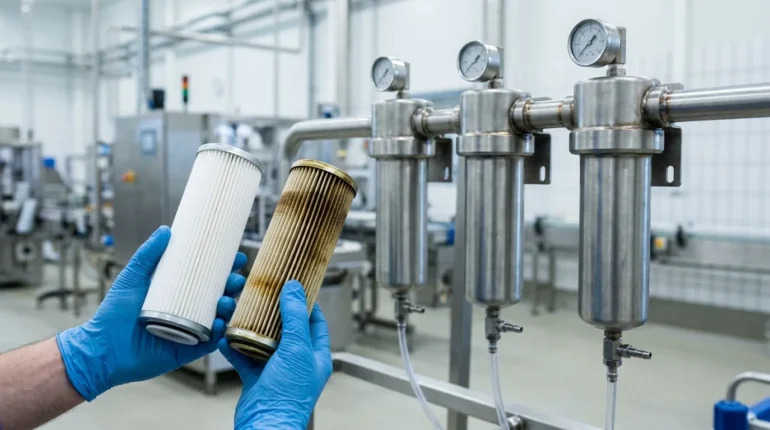
Filtration in a compressed air system is often regarded as an accessory, something bolted on after the compressor has been chosen. The air leaving a compressor tells a different story. It carries water vapour, fine particles drawn in from the surroundings and, with lubricated machines, oil in liquid and vapour form. In a humid climate the water load alone is substantial. Selecting an industrial air filter singapore is therefore a core design decision that determines what the air can safely be used for.
What Compressed Air Actually Contains
Ambient air holds dust, pollen, vehicle exhaust and water vapour. Compression concentrates all of it into a fraction of the original volume. As the air cools in the pipework, vapour condenses into liquid that mixes with rust and pipe scale. Lubricated compressors add oil aerosol and vapour. None of this is visible at the outlet of a hose, which is why contamination is usually discovered through its effects on tools, valves and finished products.
The Cost of Inadequate Filtration
Dirty air does damage gradually. Pneumatic cylinders and valves stick as lubricant is washed out or gummed up. Paint finishes show fisheyes from oil. Moisture corrodes pipework from the inside and spoils powders and packaging. In food, beverage and pharmaceutical settings, contaminated air that touches product is a compliance matter as well as a quality one. These losses seldom appear under a compressed air heading in the accounts, so they tend to be underestimated.
Air Quality Classes Explained
The international standard for compressed air purity grades air separately for solid particles, water and total oil, with lower class numbers meaning cleaner air. A specification might therefore read as three figures, one for each contaminant. General workshop tools tolerate a relatively relaxed class, while instrumentation, spray painting and direct product contact call for progressively stricter ones. Stating the required class for each use is the starting point for choosing filters; without it, selection is guesswork.
Types of Filter and Where They Sit
Different contaminants need different elements. Water separators remove bulk liquid just after the aftercooler. Particulate filters trap solids. Coalescing filters capture fine oil and water aerosols, and activated carbon stages adsorb oil vapour and odour. They are arranged in order of fineness, usually around a dryer, so that each stage protects the next. Their workload also depends on the machine upstream, and an oil-free industrial air compressor singapore plants operate will place different demands on filtration from a lubricated one.
Dryers and Filters Work Together
Filters remove liquid water and aerosols but not vapour. That is the dryer’s task. Refrigerant dryers cool the air to condense moisture and suit most general industry. Desiccant dryers reach far lower dew points for sensitive processes and outdoor pipework. A coalescing filter ahead of a desiccant dryer keeps oil off the drying medium, and a particulate filter after it catches desiccant dust. Treating the two as a single system avoids gaps in protection.
Pressure Drop and Energy
Every filter resists flow, and that resistance rises as the element loads with contaminant. The compressor must work harder to hold pressure at the point of use, and the extra energy is paid for continuously. Oversizing a housing modestly, choosing elements with low initial pressure drop and avoiding stages finer than the application needs all reduce this penalty. More filtration is not automatically better; it should match the required class and no more.
Maintenance and Element Replacement
An element left in service too long either chokes the system or, worse, releases what it has collected. Differential pressure gauges or indicators on each housing show when resistance has climbed, though many operators also replace elements at a fixed interval regardless of the reading. Automatic drains need regular checking because a stuck drain floods the filter bowl. Keeping spare elements on site and logging each change turns filtration from an occasional emergency into routine.
Point-of-Use Filtration
Not every outlet needs the same quality of air, and treating the whole plant to the strictest standard is expensive in both equipment and pressure drop. A common arrangement cleans the main supply to a general level and adds finer filters immediately before the few applications that need more, such as a spray booth, a filling line or an instrument panel. Placing the final stage close to the user also catches rust, scale and condensate picked up in the distribution pipework after central treatment.
Sizing and Sourcing
Filters are rated for a flow at a reference pressure, and that rating changes with actual operating pressure and temperature. Sizing should use the compressor’s full output and the lowest pressure the system will see. Sourcing matters too, because genuine elements with documented performance and local stock are what keep a specification valid over time. An experienced air compressor supplier in singapore can match filters, dryers and drains to the machine and confirm the resulting air quality class in writing.
Deciding What Your Operation Needs
List each point of use and assign it an air quality class based on what the air touches. Treat the whole system to the level most users need, then add point-of-use filtration for the few applications that demand more. Compare proposals on stated purity class, pressure drop and element replacement cost over several years, not on housing price. Finally, fit monitoring on every stage and commit to a replacement schedule, because a filter is only as good as its last change.