
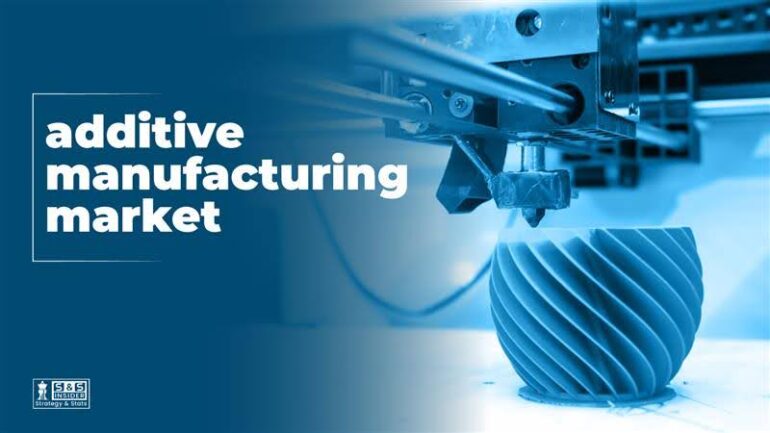
Additive manufacturing, often referred to as 3D printing, has transformed the way industries approach production. Unlike traditional subtractive methods, which involve cutting away material to create components, additive manufacturing builds objects layer by layer, offering unprecedented design flexibility, efficiency, and customization. This technology has found applications across automotive, aerospace, healthcare, consumer goods, and electronics, making it a cornerstone of modern manufacturing strategies. With the ability to reduce waste, lower production costs, and accelerate prototyping, additive manufacturing is redefining the standards of precision and innovation.
Growth Trends and Drivers
The additive manufacturing sector has witnessed remarkable growth over recent years. In 2024, the industry was valued at USD 25.04 billion and is projected to surge to USD 126.97 billion by 2032, growing at a CAGR of 22.5% during the period 2025–2032. Several factors contribute to this exponential growth, including technological advancements, increased adoption across various industries, and the growing demand for lightweight and complex components.
A primary driver is the automotive and aerospace industries, where manufacturers increasingly rely on additive manufacturing to create lightweight, high-strength parts. Reduced weight in vehicles and aircraft not only enhances fuel efficiency but also contributes to overall sustainability goals. Companies are leveraging 3D printing to produce complex geometries that are impossible or cost-prohibitive with traditional methods.
Healthcare has emerged as another critical sector propelling the growth of additive manufacturing. Customized implants, prosthetics, and dental devices are now being produced with higher precision, improving patient outcomes. Additive manufacturing enables tailored solutions for individual patients, offering both efficiency and superior performance. In addition, the development of bioprinting, which involves printing tissues and organs, is an exciting frontier expected to transform medical treatment in the coming decades.
Consumer goods and electronics industries are also embracing additive manufacturing to meet the growing demand for personalized products. From custom jewelry to intricate electronic components, additive manufacturing allows rapid prototyping and faster time-to-market. This agility helps companies respond to shifting consumer preferences while reducing costs associated with traditional tooling and inventory management.
Technological Advancements Driving Growth
Technological innovation plays a central role in the expansion of additive manufacturing. Materials science has made significant strides, offering a broader range of metals, polymers, ceramics, and composites suitable for 3D printing. High-performance materials ensure the durability, strength, and functionality of end products, making them suitable for industrial-grade applications.
Software and hardware developments have also enhanced the accuracy, speed, and efficiency of 3D printing systems. Advanced design software allows engineers to simulate and optimize structures before production, reducing errors and material waste. Meanwhile, multi-material printers and larger build volumes enable the production of more complex and larger-scale components.
Another factor accelerating growth is the integration of additive manufacturing with other technologies like artificial intelligence (AI), machine learning, and the Internet of Things (IoT). Smart manufacturing systems can monitor and control the printing process in real time, ensuring higher quality, repeatability, and operational efficiency. These advancements position additive manufacturing as a critical enabler of Industry 4.0.
Sustainability and Cost Efficiency
Sustainability has become a key consideration for manufacturers, and additive manufacturing aligns perfectly with eco-friendly practices. Traditional manufacturing often involves subtractive processes that generate significant waste. In contrast, additive manufacturing uses only the material required for the final component, drastically reducing waste. Additionally, the ability to produce parts on-demand lowers inventory requirements and transportation costs, contributing to a smaller carbon footprint.
Cost efficiency is another major advantage. While the initial investment in 3D printing equipment may be high, the reduction in material usage, tooling costs, and lead times makes additive manufacturing economically viable, especially for small to medium-scale production. Over time, these savings outweigh upfront expenditures, driving wider adoption across industries.
Challenges and Opportunities
Despite the immense potential, additive manufacturing faces certain challenges. High equipment costs, limited material availability for specific applications, and the need for skilled personnel can hinder adoption. Moreover, standardization and quality control remain concerns, especially for critical industries such as aerospace and healthcare. However, these challenges present opportunities for companies specializing in materials, software, and training services.
Governments and research institutions worldwide are also investing in additive manufacturing initiatives. Funding for research, innovation, and workforce development helps mitigate barriers while accelerating technological adoption. Strategic partnerships between manufacturers, technology providers, and academic institutions are facilitating knowledge sharing and driving the industry forward.
Future Outlook
The future of additive manufacturing is promising. As technology continues to evolve, the range of applications will expand further, and the cost of adoption will decline. Industries are likely to witness a shift from prototyping and low-volume production to full-scale manufacturing. Additionally, advances in multi-material printing, bioprinting, and large-scale construction 3D printing are expected to create new markets and opportunities.
Conclusion
additive manufacturing is more than just a technological innovation; it represents a paradigm shift in how products are designed, developed, and manufactured. From automotive and aerospace to healthcare and consumer goods, its impact is widespread and transformative. With the sector projected to grow from USD 25.04 billion in 2024 to USD 126.97 billion by 2032 at a CAGR of 22.5%, industries that embrace this technology will gain a competitive edge through enhanced efficiency, customization, and sustainability. As companies continue to innovate and overcome existing challenges, additive manufacturing is poised to redefine the future of production globally.