
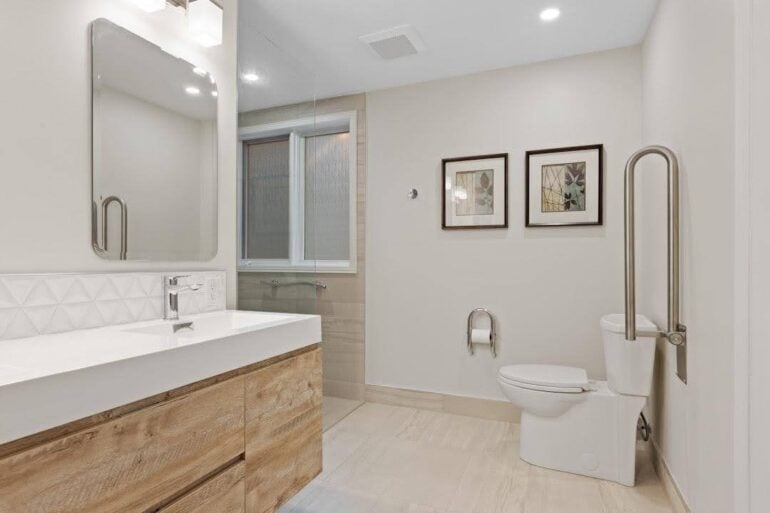
Grab bars are among the most safety-critical fixtures in any accessible restroom. Their placement is governed by detailed standards that exist to prevent falls and support safe transfers. Getting those details right is essential, not optional.
Specifiers and installers must follow precise dimensions for grab-bar location and mounting. Small errors can render a bar noncompliant or unsafe. Attention to the specifics protects users and projects alike.
Why Is Grab Bar Placement Regulated?
Grab bar placement is regulated because it directly affects user safety. People transferring to and from fixtures rely on bars positioned within reach. Incorrect placement undermines that support.
Accessibility standards translate that safety need into specific requirements. The rules cover height, length, and location. Compliance ensures the bars function as intended.
What Heights and Dimensions Apply?
Accessible design standards specify grab-bar mounting heights and clearances. Bars are generally mounted with their tops in a defined range above the floor, commonly cited between thirty-three and thirty-six inches. A clearance of about an inch and a half is required between the bar and the wall.
Installers selecting compliant hardware often specify stainless-steel ADA compliant grab bars engineered to the required mounting heights and wall clearances, since the dimensions are too consequential to approximate. Correct hardware makes meeting the standard straightforward.
Length and position requirements vary by fixture and wall. Side and rear walls have distinct specifications. Following each prevents costly rework.
What Structural Support Is Required?
Grab bars must withstand significant force without failing. Standards require the assembly to resist a substantial load applied in any direction. That demand drives the mounting approach.
Adequate blocking or reinforcement behind the wall is essential. The bar is only as strong as its anchorage. Specifiers plan for that support during construction.
What Placement Factors Matter Most?
Several factors determine whether grab bars perform correctly. The details that require attention include:
- Mounting height within the specified range
- Required clearance between the bar and wall
- Correct length on side and rear walls
- Adequate structural blocking for load resistance
- Position relative to the fixture being served
Each detail contributes to a safe, compliant installation. Overlooking any one can compromise the result. Coordination among trades keeps them aligned.
How Does Material Choice Factor In?
Material choice affects durability and hygiene in grab-bar installations. Stainless steel resists corrosion and cleans easily, suiting demanding environments. The right material extends service life.
Surface finish can also support safe gripping. Some bars feature textured or peened surfaces for traction. These options enhance usability.
What Should Specifiers Confirm?
Specifiers should confirm that placement meets every applicable dimension. Verifying heights, clearances, and lengths before installation avoids failures. The standards leave little room for approximation.
Confirming structural support is equally important. Blocking must be in place to handle the required load. That verification protects both users and the project.
How Does Installation Quality Affect Safety?
Installation quality is as important as correct specification. A bar mounted to inadequate backing can fail under load. Proper anchorage is what makes the dimensions meaningful.
Skilled installation also ensures bars sit level and secure. Loose or misaligned hardware undermines user confidence. Careful work protects both safety and durability.
What Maintenance Keeps Grab Bars Safe?
Maintenance keeps grab bars reliable over their service life. Periodic checks confirm that anchorage remains tight and the surface intact. Catching looseness early prevents a safety lapse.
Cleaning supports both hygiene and grip. Stainless surfaces wipe down easily and resist corrosion. Routine care preserves the bar’s function for years.
Grab-bar placement is a safety-critical detail governed by precise, well-established standards. Following the specified heights, clearances, and structural requirements is what makes a restroom genuinely accessible.
What Happens During a Grab Bar Inspection?
Inspectors evaluating grab bar compliance typically measure mounting height, wall clearance, and length directly against code tables, and will flag even minor deviations from the specified ranges. There is little tolerance for approximation in this particular category of accessibility hardware.
Failed inspections over grab bar placement are a common and entirely avoidable source of construction delay. Verifying dimensions against the applicable code before installation begins, rather than after, prevents this costly rework.
How Should Existing Grab Bars Be Evaluated in Renovations?
Renovation projects should not assume existing grab bars meet current standards, since code requirements have been revised over the years and older installations may reflect an outdated version of the requirements. A quick measurement check against current standards is worthwhile even when a bar appears undamaged.
Replacing an outdated bar during a broader renovation is far more economical than addressing it as a standalone project later. Bundling this check into any planned restroom work is a straightforward way to close the gap.
What Load Testing Confirms Proper Installation?
Manufacturers typically rate grab bars to withstand a specified load applied in multiple directions, and installers can verify this rating is met through the blocking and anchoring method used during installation, not the bar itself. A high-quality bar mounted to inadequate blocking still fails to meet the functional standard.
Some jurisdictions require documentation of the blocking method used behind the wall before final inspection sign-off. Keeping that documentation on file protects both the installer and the building owner if questions arise later.
For specifiers, the practical lesson is to treat every dimension as non-negotiable. Correct placement and solid anchorage are what allow grab bars to do their job.