
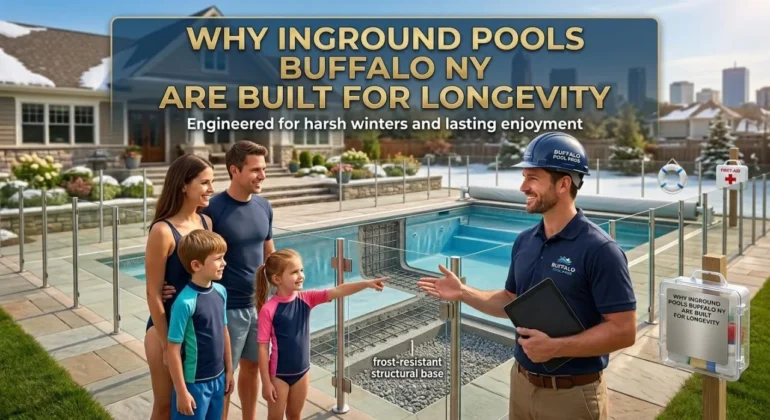
Building an outdoor swimming pool in Western New York demands an engineering approach vastly different from constructing one in warm southern states. With regional winter temperatures routinely dropping well below freezing and frost depth penetrating up to 42 inches into the soil, backyards across Erie and Niagara counties undergo extreme hydrostatic pressure and frost-heave forces every single year.
A pool installed in the Buffalo region cannot simply be built to hold water during the summer; it must be engineered to withstand heavy snow loads, sub-zero temperatures, and severe ground displacement over winter. Choosing high-performance inground pools buffalo ny ensures that your backyard installation is structurally customized to absorb these seasonal stressors, maintain its structural integrity, and provide decades of summer enjoyment without succumbing to costly structural failures.
Understanding Western New York’s Freeze-Thaw Dynamic
The single greatest threat to long-term pool survival in Buffalo is the freeze-thaw cycle. Between late October and early April, Western New York experiences frequent temperature fluctuations that hover right around the freezing mark. Water saturated in the heavy clay soils characteristic of the region expands by approximately 9% when converting from liquid to solid ice.
This volumetric expansion exerts tremendous force on submerged structures in two distinct ways:
- Lateral Hydrostatic Pressure: Ice-saturated soil expands horizontally against pool walls, threatening to bow vinyl framing, fracture unreinforced concrete, or crack fiberglass shells.
- Vertical Frost Heaving: Ground moisture freezes beneath decking, coping, and equipment pads, expanding upward and lifting unanchored structures, which leads to cracked plumbing, broken tiles, and uneven concrete slabs.
Engineering an inground pool for this severe environment requires specialized structural reinforcement, flexible plumbing systems, precise site excavation, and advanced backfill materials that allow water to drain away from the shell before it can freeze.
Comparative Material Performance in Cold Climates
Different structural materials handle cold-weather movement and soil expansion in unique ways. The matrix below illustrates how vinyl liner, fiberglass, and concrete/shotcrete pools compare when installed under Western New York climate conditions.
|
Engineering Attribute |
Structural Steel & Vinyl Liner |
High-Spec Fiberglass |
Air-Entrained Shotcrete / Concrete |
|
Average Structural Lifespan |
25 – 35+ Years |
30 – 50+ Years |
50+ Years |
|
Freeze-Thaw Resistance |
Superior: Flexible wall panels & liner absorb ground shift |
High: Tensile strength allows shell to flex slightly without cracking |
Moderate-High: Requires air-entrainment additives & dense aggregate |
|
Soil Displacement Adaptability |
Excellent |
Very Good |
Rigid (Requires extensive gravel sub-base) |
|
Waterline Surface Protection |
UV-Stabilized 27-mil Vinyl |
NPG Gelcoat (Resists ice micro-crazing) |
Pebble/Quartz Aggregate (Resists spalling) |
|
Sub-Base Drainage Requirement |
Clean #57 Crushed Stone |
Gravel Envelope + Sump Well |
Engineered Stone Gravel Bed |
|
Maintenance Cycle Frequency |
Liner replacement every 8–12 years |
Minimal surface maintenance |
Resurfacing / Acid Wash every 10–15 years |
Key Structural Engineering Features for Cold-Climate Pools
1. Heavy-Duty Wall Panel Systems and Galvanization
For vinyl liner pools, structural integrity depends entirely on the perimeter wall panels. Standard galvanized steel panels often degrade when exposed to acidic soils and constant ground moisture. Long-lasting installations utilize heavy-gauge G230 zinc-coated galvanized steel or non-corrosive structural polymer panels. These panels are further reinforced with x-brace structural A-frames set in solid concrete footings poured well below the local frost line.
2. Air-Entrained Concrete Formulations
When concrete or shotcrete pools are installed in northern regions, standard concrete mixes will quickly spall and crack under freezing conditions. Builders incorporate air-entraining admixtures, which introduce billions of microscopic air bubbles into the concrete matrix. These microscopic voids act as internal expansion chambers, allowing trapped moisture within the shell to freeze and expand without inducing internal stress fractures.
3. Deep-Gravel Excavation and Hydrostatic Relief
Preventing frost damage starts beneath the pool shell. Quality installations involve over-excavating the basin and lining it with clean, angular aggregate (such as #57 washed stone). This creates a porous drainage envelope that directs groundwater away from the pool structure. Additionally, installing a hydrostatic relief valve in the main drain prevents high water tables from floating or lifting the pool during the spring thaw when groundwater levels peak.
4. Flex-PVC and Rigid Plumbing Configurations
Plumbing lines buried in Western New York must endure ground settling and severe thermal contraction. Professional builders utilize heavy-wall Schedule 40 rigid PVC for straight underground runs laid on a compacted gravel bed, paired with high-grade flexible PVC at critical junction points. Placing plumbing lines 24 to 36 inches below grade insulates them from surface frost penetration.
Step-by-Step Anatomy of Cold-Climate Construction
Building an inground pool engineered for longevity requires a strict, multi-stage construction workflow designed to counteract seasonal soil movement.
1.Step 1: Precision Excavation and Sub-Base Preparation:Over-excavation & Drainage Layer.
Excavating the pool basin beyond standard dimensions to allow for a continuous 6 to 12-inch bed of clean crushed aggregate (#57 stone). This forms an active groundwater drainage envelope beneath the floor and around main drain hydrostatic relief valves.
2.Step 2: Structural Framing and Frost-Line Anchoring:Deep Footings Below 42 Inches.
Assembling structural polymer or heavy-gauge galvanized steel wall panels with rigid A-frame bracing. Concrete collar footings are poured around the base of the pool frame extending below the local 42-inch frost penetration line to prevent upward vertical heave.
3.Step 3: Deep Trench Schedule 40 Plumbing Installation:Trenching & Pressure Diagnostics.
Laying heavy-wall Schedule 40 rigid PVC lines on smooth gravel beds deep within trenches. All return lines, skimmer runs, and main drain connections undergo static hydrostatic pressure testing at 35 PSI for a minimum of 24 hours prior to backfilling to verify leak-free integrity.
4.Step 4: Non-Expansive Aggregate Backfilling:Eliminating Hydrostatic Pockets.
Backfilling the outer wall perimeter strictly using angular crushed stone rather than native clay-heavy excavated dirt. Clean gravel self-compacts, eliminates air voids, and prevents water from pooling directly against exterior panel walls where it could expand into ice.
5.Step 5: Deck Isolation and Expansion Joint Sealing:Isolating Deck Movement.
Pouring surrounding concrete deck slabs over prepared gravel sub-bases. High-density closed-cell foam expansion joints are placed between the pool coping and the concrete deck to ensure that winter deck movement does not transfer structural shock directly to pool walls.
Crucial Winterization Protocols for System Preservation
Even the most structurally sound pool will suffer mechanical or plumbing damage if improperly winterized. Protecting underground plumbing, filtration equipment, and internal surfaces requires an exhaustive winterization strategy executed before the first hard freeze in late autumn.
[ Water Level Lowered ] ──► [ Deep Plumbing Blowout ] ──► [ Anti-Freeze & Rubber Plugs ] ──► [ Safety Cover Secured ]
- Deep Plumbing Blowouts: Commercial-grade air compressors blow all water out of suction, return, main drain, skimmer, and water feature plumbing lines until air bubbles purge freely.
- Antifreeze and Plugs: Non-toxic propylene glycol pool antifreeze is added to low-lying lines, and expandable rubber or threaded winterizing plugs with O-rings are sealed tightly into all wall returns and skimmers.
- Skimmer Protection: Expansion devices (such as Gizzmos) are threaded into skimmer housings to absorb ice expansion forces and prevent housing cracks.
- Equipment Pad Draining: Pumps, filters, heaters, chlorinators, and salt cells are completely drained of residual water via bottom drain plugs. Mechanical components are stored indoors or protected with weatherproof, breathable covers.
- Water Level Adjustment: Water levels are lowered below the skimmer mouth or tile line (depending on pool surface material) to allow room for ice formation without putting pressure on coping stones or tile beds.
- Heavy-Duty Safety Covers: ASTM-certified mesh or solid safety covers, anchored directly into the surrounding concrete deck with flush-mounted brass anchors, prevent snow accumulation from entering the pool while supporting high snow loads.
Essential Maintenance Checklist for Long-Term Durability
Maintaining structural integrity requires year-round diligence, spanning pre-season startup, active summer balance, and post-season winter protection.
Spring Commissioning (April – May)
- [ ] Remove, clean, and dry the winter safety cover before folding for storage.
- [ ] Reinstall drained equipment plugs, pressure gauges, sight glasses, and salt cells on the equipment pad.
- [ ] Inspect the surrounding concrete decking and coping for new frost heave cracks or line shifting.
- [ ] Slowly remove winter plugs while monitoring for pressure drops that could indicate concealed pipe damage.
- [ ] Balance water chemistry, paying special attention to Calcium Hardness (target 200–400 ppm) to protect plaster and vinyl surfaces from water aggressiveness in cold temperatures.
Active Season Upkeep (June – September)
- [ ] Maintain pH between 7.2 and 7.6 and Total Alkalinity between 80 and 120 ppm to prevent LSI (Langelier Saturation Index) imbalances.
- [ ] Inspect expansion joints between the coping and deck to ensure water-tight seals prevent surface water seepage into sub-grade soil.
- [ ] Monitor pump strainer baskets and skimmers weekly to maintain optimal circulation pressure and filtration rates.
- [ ] Clean water filtration media (backwash sand/DE or rinse cartridges) when operational pressure rises 8–10 PSI above baseline.
Autumn Winterization (Late September – October)
- [ ] Balance chemistry 7–10 days prior to closing, adding a slow-release winterizing algaecide kit.
- [ ] Perform deep line blowouts and seal all pool openings with heavy-duty expandable rubber plugs.
- [ ] Drain all above-ground equipment, valves, and heating heat-exchangers entirely.
- [ ] Install skimmer freeze-absorption devices and double-check spring tensioning on the safety cover.
Frequently Asked Questions
1. What is the best type of inground pool for handling Buffalo’s soil and frost conditions?
Vinyl liner pools with structural polymer or heavy-galvanized steel walls and fiberglass pools are exceptionally popular in Western New York. Both offer subtle flexibility that accommodates ground movement during freeze-thaw cycles without cracking. Concrete pools can also last generations in this climate, provided they are built with air-entrained concrete, dense aggregate finishes (like pebble or quartz), and backed by thorough gravel drainage systems.
2. How deep should pool plumbing lines be buried in Western New York?
Plumbing lines should ideally be buried 24 to 36 inches below grade on a compacted bed of clean aggregate. While standard frost depth can reach up to 42 inches in severe winters, blowing out water lines with compressed air and sealing them with expandable plugs during winterization ensures that lines remain completely dry and safe from freeze damage regardless of burial depth.
3. How do expansion joints protect my pool deck from winter damage?
Expansion joints act as a buffer between the rigid pool coping and the surrounding concrete deck. Because concrete decks expand and contract with seasonal temperature swings, an expansion joint filled with flexible sealant prevents the deck from pushing directly against the pool wall, protecting coping stones, tile lines, and pool walls from cracking.
4. Why is crushed aggregate used for backfilling instead of native soil?
Native Western New York soil contains high concentrations of clay, which holds onto moisture and expands significantly when frozen. Backfilling with clean, angular crushed stone (#57 gravel) creates a self-compacting, non-expansive layer that allows water to drain freely into sub-grade drainage systems before it can freeze against pool walls.
5. Do I need a heater to enjoy an inground pool in Buffalo?
While not structurally mandatory, a heating system (such as a gas heater or commercial heat pump) is strongly recommended for Western New York installations. A dedicated heater can comfortably extend your regional swimming season by two to three months, opening the pool as early as May and keeping it warm through late September.
Conclusion
Investing in an inground pool in Buffalo, NY, requires careful planning that accounts for the harsh realities of Northern winters. By building with heavy-duty corrosion-resistant wall panels, installing deep aggregate drainage systems below the frost line, and maintaining diligent winterization and water chemistry routines, homeowners can enjoy a stunning backyard oasis that resists freeze-thaw cycles and delivers decades of summer entertainment.