
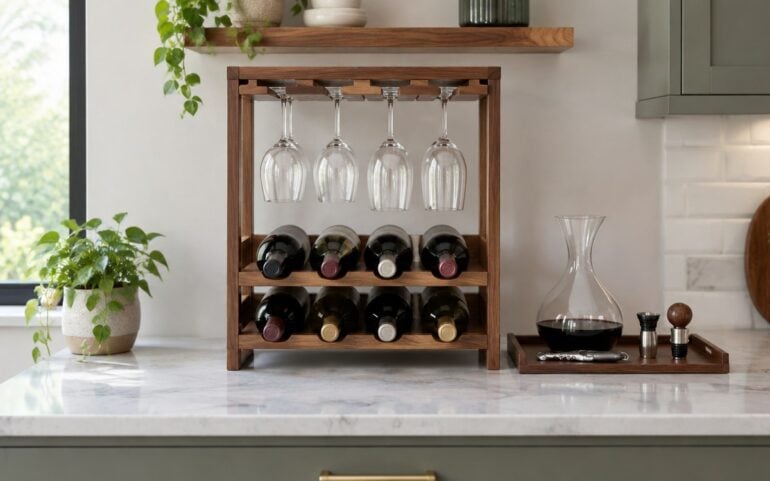
A home wine station doesn’t need a cellar, a climate-controlled cabinet or a wall of gadgets. It needs a spot in your kitchen or dining room where your bottles, glasses and tools live together, so you can open and pour without hunting through drawers. Build it around the wine you drink and it will cost less and get used more.
Start with storage
Store bottles with natural corks on their side so the corks stay moist. Keep them away from the oven, the dishwasher, direct sun and the top of the fridge, all of which run warm or vibrate. A basic rack in a closet or under a counter works for most people. If you hold bottles for years, a small wine fridge set to about 55°F protects them better than room temperature.
Screwcap bottles can stand upright with no problem.
The essentials
These cover nearly every bottle you will open.
- A reliable corkscrew. A double-hinged waiter’s corkscrew is cheap, compact and works on most corks.
- All-purpose glasses. One set of good, thin-rimmed glasses handles reds, whites and rosé. You don’t need a separate shape for every grape.
- Stoppers. A few rubber or silicone stoppers keep leftover wine for a few days in the fridge.
- A sparkling stopper. If you drink bubbles, this one keeps a half bottle lively until tomorrow.
- A cloth or towel, for drips and for wiping the bottle neck.
The nice-to-haves
Add these if your habits call for them.
- A decanter, if you open older reds with sediment or like to give young reds an hour of air before dinner.
- A pour-through aerator, if you drink young reds by the glass and don’t want to wash a decanter.
- A two-prong or dual opener, if you collect bottles that will sit for ten years or more.
- An ice bucket, if you serve white and sparkling wine at the table often.
What you can skip
Novelty gadgets, electric openers that need charging, and big multi-piece kits stuffed with tools you will never touch. Most of them end up in a drawer. Buy one piece at a time when you run into a real need.
To figure out which of the nice-to-haves fit your table, read Unhyd’s breakdown of wine serving accessories and when each one helps. It covers aerators, tabletop dispensers and openers for fragile corks, and it is blunt about where a tool adds little. Its chart pairing each bottle type with a tool makes a useful shopping filter before you add anything to your station.
Lay it out
Keep the corkscrew, stoppers and towel in one small tray or drawer next to the bottles. Store glasses nearby, upside down on a shelf or hanging from a rack. Keep the decanter where you can see it. You will use it more if you don’t have to dig it out.
Keep it clean
Rinse glasses and decanters with hot water and go easy on soap, which can leave a film that dulls aroma. Let decanters dry upside down on a rack or a clean towel. Rinse aerator filters right after use so wine doesn’t dry inside them.
Grow it slowly
Track what you open for a month. If most of your bottles are young reds, an aerator or decanter makes sense. If you mostly drink white and sparkling, an ice bucket and a good stopper matter more. Let your habits tell you what to buy next.
A good wine station is small, tidy and built around what you drink. Start with the essentials, add tools when you need them, and keep everything within reach.