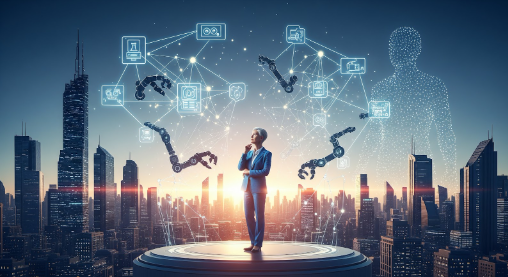
Automation has moved far beyond the factory floor. It powers recommendation engines, manages logistics, and even drafts legal documents. While these advances promise efficiency, they also raise an unsettling question: is automation freeing people from limitations, or is it beginning to define what it means to be human?
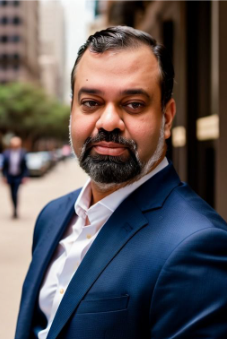
AI pioneers around the world are weighing in. Among them is Sam Sammane, founder of TheoSym and author of The Singularity of Hope, who frames the issue in stark terms: technology should serve liberation, not identity.
The Evolution of Automation and Human Identity
Automation has always shifted human roles. Looking back at its development provides perspective on why today’s AI-driven automation feels different.
Industrial revolutions and shifting roles
The first machines of the 18th and 19th centuries replaced physical labor. Artisans lost authority over their craft as machines standardized production. While output soared, the human role narrowed.
Digital automation in the 20th century
Computers brought optimization at scale. Employees became system operators, relying on software for calculation, storage, and management. Authority began consolidating in systems, and efficiency was prioritized over individuality.
Why AI-driven automation is unique
Unlike earlier tools, AI simulates reasoning and decision-making. This means automation no longer just executes—it influences judgment and behavior. The result is a deeper challenge to freedom and self-definition.
Sam Sammane’s Perspective: Automation as Liberation, Not Identity
Sam Sammane has spent his career at the intersection of technology and ethics. As a thought leader and founder of TheoSym, he advocates for automation that amplifies human purpose instead of shrinking it.
Why freedom is the measure of technology
Sammane argues that efficiency cannot be the ultimate benchmark of progress. True advancement is measured by the freedom it grants individuals to think, create, and live meaningfully.
“We often confuse efficiency with progress. A society defined only by speed and optimization risks hollowing itself out. Automation should strip away burdens, not strip away meaning,” Dr. Sam Sammane said.
“The goal of every technological leap must be to expand our horizon of freedom, not to bind us more tightly to systems that decide for us.”
Preserving human agency in decision-making
For Sammane, automation is valuable only if humans remain authors of their choices. To allow machines to define roles or values is, in his view, a quiet surrender of authority that undermines both dignity and responsibility.
The Dangers of Letting Automation Define Humanity
When automation shifts from being a tool to becoming an arbiter of human roles, the consequences extend beyond efficiency. Sammane warns that the quiet creep of definition—where machines decide how humans live, work, and even think—poses one of the greatest risks of this era.
Loss of purpose and identity
If machines assume tasks once tied to meaning—mentorship, judgment, creative authorship—humans may experience an erosion of purpose. Work has always been more than output; it is a way of situating oneself in society. Automation that defines those roles strips away that anchor.
Automation bias in decision-making
People tend to defer to systems that appear precise. This “automation bias” can be dangerous, especially in high-stakes fields. When humans unquestioningly follow algorithmic outputs, they surrender both judgment and responsibility.
- Medical diagnostics where AI is trusted without review.
- Hiring systems that filter candidates with hidden biases.
- Legal risk assessments that shape sentencing recommendations.
“Dependence begins subtly. A recommendation here, a shortcut there. Over time, the human role becomes reduced to compliance. That is not freedom,” he warns. “It is quiet captivity disguised as convenience. Automation must assist, never define, if we are to remain truly human.”
Reclaiming Automation as a Tool of Freedom
The challenge is not to reject automation, but to reclaim its role as liberator. Sammane insists this requires deliberate effort in design, governance, and culture.
Designing human-centered systems
Automation should support human creativity and decision-making. Human-in-the-loop models guarantee that while machines handle repetition, humans retain the final voice.
Defining ethical boundaries
Some areas must remain firmly in human hands.
- Justice: Authority to judge requires empathy and context beyond data.
- Healthcare: Machines can aid but not replace the moral weight of care.
- Governance: Decisions that shape communities must be made by accountable leaders, not algorithms.
Building cultures of critical awareness
Beyond technical frameworks, Sammane emphasizes culture. Education must teach skepticism of machines, encouraging individuals to interrogate rather than accept automation. Leaders must model this resistance to passive deference.
TheoSym’s Human-First Approach
Sammane’s philosophy is not only theoretical. TheoSym, the company he founded, demonstrates a model of Human-AI Augmentation (HAIA) that aligns with his vision.
How TheoSym reimagines automation
Where many tech firms race toward full automation, TheoSym designs systems to amplify human strengths. Virtual assistants, for example, streamline routine work but leave humans to make the interpretive and strategic calls.
A contrast to Big Tech’s paradigm
While Big Tech often equates automation with progress, TheoSym emphasizes meaning and freedom as the true benchmarks. This human-first philosophy sets it apart in a landscape dominated by efficiency metrics.
The Future of Automation and Human Authority
The question that remains is not whether automation will advance—it will—but whether humans will choose to shape it with freedom in mind.
Preserving authorship in an automated age
If society insists on preserving authorship, automation can be a profound ally. If not, it risks becoming a subtle cage that redefines what it means to live meaningfully.
“The test of our age is not how far automation can go, but how firmly we hold onto our authorship of life. Technology must be the servant of freedom, never its master. Only then will progress carry the dignity it promises,” he concluded.